
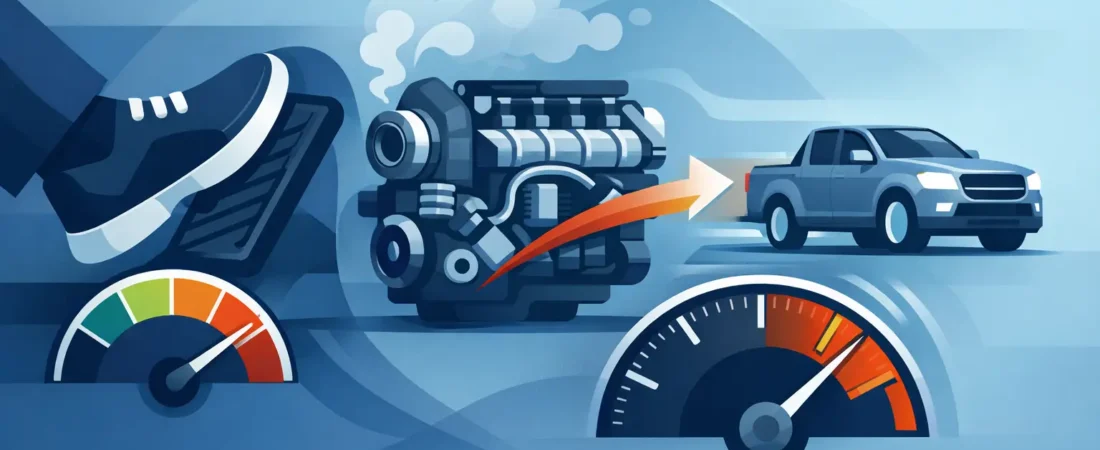
A diesel that feels flat when you pull away is more than annoying. It makes the car harder to drive smoothly, slower to react at roundabouts, and far less pleasant in daily use. If you are wondering how to improve diesel throttle response, the answer is usually not one single magic part. Most of the time, it comes down to airflow, fuelling, boost control, and the software that manages them.
Good throttle response in a diesel feels simple – you press the pedal and the car moves cleanly, without hesitation, dead spots, or a lazy wait for torque to arrive. When that response goes off, the cause might be a fault, a restriction, or just a factory calibration that prioritises emissions and economy over drivability.
What poor diesel throttle response actually feels like
Drivers describe it in different ways. Some say the car feels sleepy below 2,000rpm. Others notice a pause between pressing the accelerator and the engine picking up. On turbo diesels, it can feel like nothing happens at first, then the boost arrives all at once.
That matters because poor response is not always about outright power. A diesel can still make decent top-end torque and yet feel slow to react in normal driving. If the issue is hesitation off the line, weak mid-range pickup, or a delayed turbo spool, you need to focus on what is affecting low and mid-range drivability rather than peak bhp figures.
How to improve diesel throttle response without guessing
The first job is working out whether you are dealing with a mechanical problem or a calibration issue. If the car used to respond well and has recently gone flat, assume something is wrong before spending money on performance parts. If it has always felt dull, especially from the factory, then software and sensible supporting changes can make a real difference.
A proper diagnosis saves time. There is no point fitting parts or asking for tuning if the engine is already struggling with low boost, poor sensor readings, or a blocked emissions system.
Start with faults and basic health checks
Modern diesels rely on accurate sensor data and tightly controlled boost. A small issue can make the whole car feel lazy. Fault codes are an obvious place to start, but even without a warning light, problems can still be there.
A sticking EGR valve can dilute the intake charge at the wrong time and make the engine feel sluggish. A tired MAF sensor can under-read airflow and soften response. Split boost pipes, vacuum leaks, sticking turbo actuators, and intercooler leaks can all delay torque delivery. If the DPF is heavily loaded, the engine may feel restricted, especially if it is constantly trying to manage soot levels.
Servicing matters as well. Old fuel filters, poor-quality oil, overdue air filters, and injector issues can all blunt response. None of these are glamorous fixes, but they are often the reason a diesel feels worse than it should.
Check for airflow and boost restrictions
Diesels respond well when they can move air properly. If airflow is restricted, response suffers first. A clogged air filter is the simple end of it. More serious issues include carbon build-up in the intake, a sticky EGR system, or boost leaks that stop the turbo from delivering pressure cleanly.
Turbo lag and poor throttle response are not exactly the same thing, but they overlap. Some lag is normal on many diesel engines, especially larger turbo setups. Excessive lag is not. If the turbo is slow to build, inconsistent, or only wakes up high in the rev range, that points to a control or hardware issue worth checking properly.
ECU tuning and diesel throttle response
If the engine is healthy, ECU calibration is one of the most effective ways to improve diesel throttle response. Factory maps are often conservative. They are written to suit emissions targets, fuel quality variation, broad climate conditions, and long-term durability targets across thousands of vehicles. That usually leaves room for sharper pedal response and stronger low-down torque.
A well-written remap can alter how the engine responds to pedal input, how boost is requested, and how torque is delivered through the rev range. The aim is not just more power on paper. It is making the car feel more immediate and easier to drive.
This is where a lot of drivers notice the biggest real-world change. The vehicle pulls sooner, picks up cleaner in higher gears, and needs less throttle input to get moving. On a daily driver, that often matters more than an impressive dyno number.
Stage 1 remap vs hardware changes
For most road cars, a Stage 1 remap is the best starting point. If the vehicle is standard and in good health, software alone can usually sharpen response far more effectively than random bolt-on parts. It is also the sensible option if you want a noticeable improvement without turning the car into a project.
Stage 2 setups can improve response as well, but only when the supporting hardware is matched properly. That may involve intake, exhaust, or intercooler changes depending on the platform. Done well, it works. Done badly, it can create more noise, more expense, and very little gain where you actually use the car.
Emissions systems and delayed response
On many diesels, emissions equipment is part of the drivability problem. That is not true in every case, and it should never be assumed without testing, but systems such as EGR, DPF, and AdBlue can contribute to poor running when they start causing faults or restrictions.
A DPF that is struggling to regenerate properly can leave the vehicle feeling strangled. An EGR valve that is sticking can upset combustion and make the engine feel hesitant. In some cases, warning lights and limp-mode behaviour are the obvious signs. In others, the car just feels dull, inconsistent, and harder to drive smoothly.
This is why blanket advice rarely helps. One diesel may only need a proper remap. Another may need fault-finding first because the hardware is already holding it back. For drivers in Kent using their cars for commuting or work, sorting the root cause quickly usually matters more than chasing theoretical upgrades.
Cheap fixes that rarely fix much
There is no shortage of products claiming to sharpen throttle response. Plug-in tuning boxes, pedal boxes, fuel additives, and universal induction kits all get talked about. Some have a place, but most are over-sold.
A pedal box can make the accelerator feel more sensitive, but it does not create torque. It changes the relationship between pedal movement and throttle request, which can make the car feel livelier at first. If the engine is genuinely flat because of poor mapping or a fault, it does not solve the underlying issue.
Fuel additives can help in specific cases, especially if injector cleanliness is part of the problem, but they are not a substitute for proper diagnosis. As for cheap tuning boxes, many simply manipulate sensor signals rather than properly recalibrating the ECU. Results can be inconsistent, and drivability is not always better.
When hardware upgrades make sense
If you are already at the limit of the standard setup, hardware starts to matter more. A freer-flowing intake path, better intercooling, or supporting exhaust changes can help the engine respond more cleanly under load. But these upgrades should follow a plan, not guesswork.
Bigger is not always better on a road diesel. A large turbo might support stronger peak power, but it can also shift the torque delivery higher up the rev range and make the car feel less responsive in normal use. For a daily-driven diesel, usable torque and clean response usually matter more than chasing headline numbers.
What the best fix usually looks like
In practice, the best result usually comes from three things done in the right order. First, make sure the engine is healthy and free from faults. Second, sort any airflow, boost, or emissions-related issues that are affecting performance. Third, apply a proper ECU remap that is written for the vehicle and its condition.
That approach gives you a diesel that reacts properly when you ask for power, rather than one that just feels artificially aggressive at the pedal. It is the difference between a car that is nicer to drive every day and one that only feels quicker for ten minutes.
If your diesel is hesitating, lagging, or just feels half-awake, do not start with random parts. Start with the basics, get the engine checked properly, and then improve it in a way that suits how you actually use the car. The right setup should make the vehicle feel sharper, smoother, and more willing every time you pull away.